
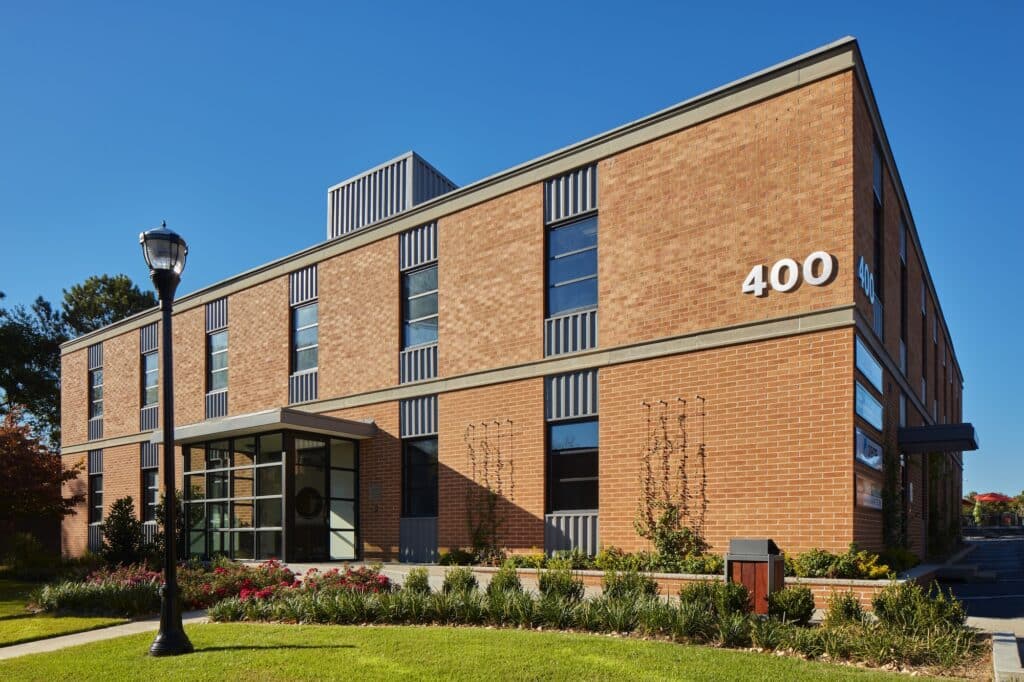
For years, office success looked like a corner suite in a glass tower, and the more square footage, the better. That picture has changed. Across Atlanta, businesses are rethinking how much space they need and what that space should do for them. The result is a clear shift toward smaller, more efficient, and more distinctive workplaces driven by thoughtful office space optimization.
The Numbers Behind the Shift
Atlanta’s office market is sending a clear signal. According to Newmark’s Q2 2026 Atlanta office report, leasing activity came in at 2.0 million square feet, still under historical norms, and the number of deals slowed to 364 as tenants continued to favor smaller, more efficient space.
Tenants are still committed to the office, and they’re getting pickier. More companies moved in than moved out during the quarter, producing roughly 604,000 square feet of net absorption and bringing vacancy down to 26.1%, though that figure remains close to recent cycle highs. High vacancy alongside positive absorption tells an important story: demand is real, but it’s flowing toward specific kinds of space, not spreading evenly across the market.
Cost is part of the equation, too. Full-service asking rates rose 3.7% year over year to a record $33.93 per square foot. When every square foot costs more, leasing space you don’t use gets harder to justify without an effective strategy for office space optimization.
What Is Office Space Optimization?
Office space optimization is the practice of matching a workplace’s size, layout, and features to how people actually use it. For tenants, it means paying for square footage that supports real daily work. For building owners, it means configuring suites, amenities, and lease terms around what the market will lease and renew.
Record rents make that match more valuable every quarter. A tenant who trims 1,000 unused square feet at today’s asking rates keeps roughly $34,000 a year in the business, and an owner who reconfigures a stalled floor into leasable suites turns dead space into income. Both sides of the lease benefit when the space fits the work.
Why Right-Sizing Makes Sense Now
- Hybrid work changed the math. Most teams no longer need a desk for every employee every day. They need a reliable home base for collaboration, client meetings, and culture, which usually takes a fraction of the footprint they used to lease.
- Smaller spaces work harder. A well-designed 2,500-square-foot suite with open work areas, a conference room, and a few private offices can outperform a larger floor plate that sits half-empty most of the week.
- Character matters. When the office has to earn the commute, the environment counts. Exposed brick, high ceilings, natural light, and a walkable neighborhood give employees a reason to show up. Generic cubicle floors rarely do.
- Flexibility reduces risk. Smaller spaces often come with more manageable commitments and layouts that can adapt as a business grows or changes direction.
West Midtown: Where Right-Sizing Meets Character
If there’s one Atlanta neighborhood that captures this shift, it’s West Midtown. Once an industrial district, the area has been reinvented with creative office campuses and loft-style workplaces that draw design, media, and startup companies. According to Savills, many of its old industrial buildings have been converted into creative office space, and the neighborhood has grown into one of the city’s liveliest destinations for dining and entertainment.
That transformation created exactly the product today’s tenants want: smaller suites with real architectural character in a neighborhood people actually enjoy spending time in.
At Armour Junction, we’ve seen this demand for office space optimization firsthand. This West Midtown property is currently 100% leased and home to a wide variety of tenants, including a law firm, architectural firm, interior designer, and even a branch of the USPS. The loft office structure and flex designation allow this versatile asset to accommodate a wide range of quality tenants and can adapt as their business needs shift, leading to more leasing renewals. These tenants choose Armour Junction for its prime Atlanta location, desirable loft office layouts, and reliable, honest property management provided by EpiCity Real Estate Services. Employees love Armour Junction due to its central location, walkability near the Atlanta BeltLine, and its carefully curated grounds, which include many spaces to unwind.
A fully leased building in an Atlanta market with 26% vacancy reflects attentive property management and strong leasing strategies, but also where Atlanta office demand is heading. We believe the data suggests commercial tenants are leaning towards finding spaces that are the right size, have the right flexibility, and sit in the right location.
What This Means for Your Business
If your lease is coming up for renewal or your team has outgrown (or downsized) its current setup, ask yourself these questions before you sign:
- How many people are actually in the office on a typical day?
- Which spaces get used most: desks, meeting rooms, or collaboration areas?
- Does your current office help you recruit and keep talent, or does it work against you?
- Would a smaller, better-designed space in a more vibrant neighborhood serve you better than more square footage?
For a growing number of Atlanta businesses, the answer points to less space, better layout, and prioritizing office space optimization.
Do You Own an Underperforming Property? The Right Management Team Makes the Difference
The shift toward smaller, character-driven space is a real opportunity for owners of underperforming buildings, but only if a property is positioned to capture it. In a market where roughly one in four square feet sits empty, the gap between buildings that lease and buildings that linger often comes down to how they’re managed.
Your asset may need a new approach if you’re seeing any of these warning signs:
- Vacancy that lingers while comparable buildings nearby are leasing
- Large, undivided suites that no longer match how today’s tenants use space
- Rising operating costs or a growing list of deferred maintenance
- Tenants leaving at renewal, or renewals becoming harder to secure
- Slow response to leasing inquiries and little visibility in the market
A strong property management partner can turn those issues around. Here’s what the right team brings to the table:
- Repositioning for current demand. Evaluating whether larger suites should be divided into smaller, move-in-ready units, and identifying the improvements that give a building the character tenants are looking for. Stabilizing and repositioning an underperforming asset starts with an honest read on what the market wants.
- Proactive leasing and marketing. Presenting the property to the right prospects, responding quickly, and telling a compelling story about the building and its neighborhood.
- Tenant retention. Responsive service and regular communication keep good tenants in place, which is almost always less expensive than replacing them.
- Operational discipline. Controlling costs, planning capital improvements strategically, and providing clear financial reporting so owners always know where their asset stands.
How to Choose the Right Partner for Office Space Optimization
| What to Look For | Why It Matters | How EpiCity Delivers |
|---|---|---|
| Deep local market knowledge | Submarket conditions decide which strategy pays off | Atlanta real estate experience since 1935 |
| Vertically integrated services | Fewer handoffs mean faster projects and tighter budgets | In-house property management, construction, and facility maintenance |
| Distressed asset experience | Early intervention protects cash flow and limits liability | Distressed Asset Services, including court-appointed receivership |
| Capital investment expertise | Every improvement should support long-term value | ROI optimization, capital formation, and 1031 exchange strategy |
| Clear accountability | Owners need fast answers and one responsible partner | A single point of contact for every client |